Disclaimer
This blog series is not created or drafted by AI. It is also not a sales pitch disguised as informative text. This is simply a real-life story of a company on the road to agentic ERP.
This is happening in real time, so I am as curious as you are to see the end result and the hurdles that lie ahead. Hopefully, by the end of this blog series, we will have a great (success?) story from which we can all learn.
Starting Point
The system that is going agentic is D365 Finance & SCM (later F&O), which includes Finance, Project, and HR modules. We were one of the first companies to adopt F&O, and it reflects its time. Meaning that quite a lot of tailored extensions have been developed.
For official reporting, we use Power BI. Jedox is used for group consolidation, and a wide variety of Excel spreadsheets have been created for everyday business planning and forecasting.
From a people perspective, top management is eager to move fast, the finance department has tons of ideas to make life easier, and internal IT is very cautious (as they should be.)
I assume this starting point sounds familiar to many companies.
Project Goal
The goal is to have the first version of an agentic ERP in use by the end of 2026. It should include at least two out-of-the-box F&O agents (Account Reconciliation Agent and Expense Management Agent) and one custom agent (Project Controller Agent).
We will be utilizing the new Dynamics 365 ERP MCP server to operate directly with ERP data, UI and business logic. Alongside this development, we will create a roadmap for 2027, during which we expect to achieve significant efficiency gains by automating and streamlining finance processes. 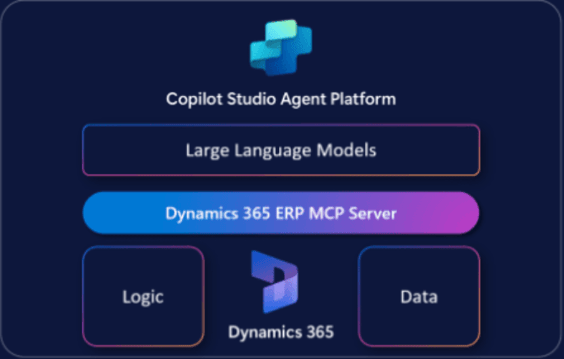
AI or Automation?
When developing an agentic ERP, we are not only talking about AI. Many of the use cases we have received are purely automation and do not require any AI to deliver value.
I have tried to list some characteristics of use cases to help determine the best approach to reach the target state. Please feel free to reach out if you disagree.
Traditional automation or reporting
|
AI
|
First Steps
At the time of writing this first part of the blog series, we have just started the project.
The first step is for me is to figure out project plan and work estimate to get internal funding. Here I must rely on the notorious crystal ball, because who knows, right? Creating new environments, configuring OOTB agents and creating custom agents for testing purposes is easy to estimate and the cost estimate is very reasonable. Taking them to production can be a completely different story. Also, the cost of running agents in production is somewhat obscure. Luckily for you, we will be able to tell you the actual costs when we get there.
The first practical action is to create a new, separate Tier 2 DEV environment where we can securely smoke-test the MCP server and experiment with OOTB agents.
In parallel, I will take the bull by the horns, meet with internal IT, and identify what needs to be investigated, tested, and confirmed before we can enable the MCP server and create AI solutions that can directly read and write production data. As our company takes cybersecurity, data security, GDPR, etc. very seriously, I expect it to be a significant effort tick all the boxes.
A positive outcome of this exercise is that we will end up with a documented AI governance model, which we can later use to support our customers in similar situations.
So, this is where we are now. I will keep you posted on the future adventures of Innofactor’s agentic ERP.
With best regards,
Jaakko Heikkinen
ENT ERP Lead